Industrial rugged embedded computers must meet strict standards for reliability, environmental protection, security, and long lifecycle performance. While many safety, connectivity, and regulatory standards apply to both commercial and industrial computers, this guide focuses specifically on the standards that matter most for industrial embedded systems deployed in harsh environments.
When designing systems for factory automation, oil and gas, transportation, food processing, or defense applications, it’s helpful to understand how component standards, form factors, mounting systems, and environmental ratings affect long-term performance.

Components and Software
A commercial single board computer (SBC) can be made somewhat rugged, but it still isn’t the same as an industrial version. Rugged embedded computers are built with stronger materials and components so they can handle extreme temperatures, shock, and vibration while still delivering reliable performance and long product life.
To survive harsh conditions, manufacturers often include:
- Rugged industrial processors. Companies such as Intel®, Arm®, NXP®, NVIDIA®, and DMP® make processor families designed to operate in extreme environments and capable of supporting robust Linux® and Windows® operating systems and the advanced applications they support.
- Rugged memory and storage. eMMC storage uses low power and is durable. Solid state drives (SSDs) also come in rugged versions. Soldering memory and storage directly to the board helps them survive vibration.
- Fanless thermal design. Rugged embedded computers usually rely on heat spreaders or heat sinks instead of fans. Removing moving parts increases reliability and helps the system operate in extreme temperatures.
- Locking connectors. These connectors keep cables from coming loose due to vibration or accidental pulling.
- Conformal coating. This thin, protective film is applied to the finished board to protect it from moisture, dust, and chemicals.
Environmental-Related Standards
Embedded computers must survive tough environments, whether it’s a touch screen in a food processing plant, a vehicle-mounted device, a welding robot arm, or a controller on an oil platform. They must resist moisture, dust, shock, vibration and extreme operating temperatures while minimizing environmental impact. Key standards include:
- IP rating (Ingress Protection): Defined by EN 60529, this rating shows how well a device is protected from dust and water. For example, an IP65 device is completely dust tight and protected against low pressure water jets.
- Vibration and shock ratings: IEC Standard 60068 defines tests for vibration, shock, drop impact, temperature cycling, humidity, and exposure to dust or salt fog. Common references include IEC 60068 2 6 (vibration) and IEC 60068 2 27 (shock). Military standards (MIL STD) require even more demanding tests.
- Operating temperature ranges: Components and the full system must work reliably within expected temperature limits. Commonly accepted ranges include:
- Commercial: 0 °C to 70 °C (32 to 158 °F)
- Industrial: −40 °C to 85 °C (−40 to 185 °F)
- Military: −55 °C to 125 °C (−67 to 257 °F)
- RoHS and REACH: These European regulations limit hazardous chemicals in electronics.
- RoHS restricts lead and nine other harmful substances.
- REACH requires companies to identify and manage chemical risks for products sold in the EU.
Form Factor Standards
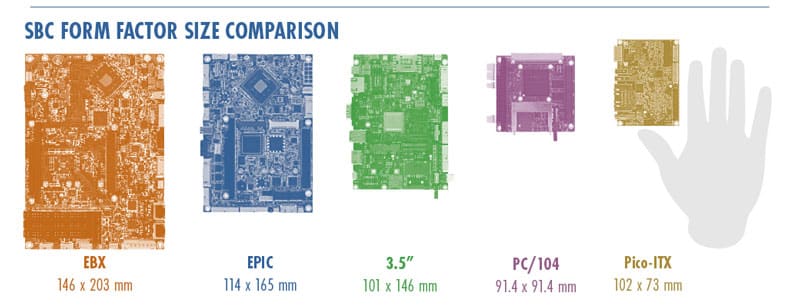
A form factor usually refers to the physical size and layout of a board. This includes board dimensions, connector types, pin layouts, and mounting hole locations. When choosing a COTS (commercial off-the-shelf) product versus custom design, keep these standards in mind.
Single Board Computer (SBC) Form Factor Standards
Rugged SBCs include all computer elements from processors and RAM to storage, connectivity, networking, and I/O in a compact board to be embedded inside of the larger device or application they support. WINSYSTEMS offers many rugged SBCs.
-
- 3.5 inch: 146mm x 102mm. Originated at Intel in the 1970s and later adopted by many companies.
- Mini ITX: 170mm x 170mm. Originally developed by VIA Technologies and later supported by Intel and many companies since.
- Nano ITX: 120mm x 120mm.
- Pico ITX: 100mm x 72mm.
- PC/104: 90mm x 96mm. A stackable board standard created by the PC/104 Consortium. It has evolved through versions like PC/104 Plus and PC 104.
- EBX: 5.75” x 8” (146mm x 203mm). Designed for flexible system expansion using industry standard components.
Learn more: Pick the SBC Form Factor That Fits Your Application Needs
Computer on Module (COM) Form Factor Standards
Common COM standards include COM Express®, SMARC™, and Qseven®. WINSYSTEMS COM products follow the COM Express standards from the PCI Industrial Computer Manufacturers Group (PICMG®).
-
- COM Express® Sizes: Available in Mini (84mm x 55mm), Compact (95mm x 95mm), Basic (125mm x 95mm), and Extended (155mm x 110mm) sizes. These sizes have mounting holes in common so carrier boards can accommodate the different sizes.
- COM Express® Connector Types: Type 10 (220 pin connectors) and Types 6 & 7 (440 pins).
Learn more: Rugged Industrial Computer-on-Module (COM) Solutions
Industrial PC Form Factor Standards
An industrial box computer includes the SBC or COM module, its thermal solution, expansion boards, and internal cables inside a protective enclosure. These systems often match the footprint of common board sizes like Pico ITX, 3.5 inch, or a COM Express Type 6 or 10.
However, for industrial PCs, mounting standards may be more important than exact case dimensions.
-
- DIN rail: This is one of the most common mounting methods. This metal rail is installed in industrial cabinets and on walls to hold electrical devices. DIN rails save space, simplify installation, and make maintenance easier. There are four standard DIN rail sizes, and many industrial computers either include DIN rail mounts or can be adapted with mounting kits.
- Wall mounting: This option uses brackets that extend from the computer’s enclosure, with screw holes at intervals.
Panel PC Form Factor Standards
Panel PC form factors usually refer to the display size. For example, WINSYSTEMS panel PCs range from 6.5” to 19” displays, with the embedded computer mounted behind the screen. These panel PCs can be ordered ready to install inside a rugged device or enclosed with ingress protection suitable for their deployment environment.
The type of touch sensor is another key standard for the human to machine interface on a panel PC.
-
- Capacitive touch: The body’s electrical energy is sensed through the glass. Capacitive screens support multi-touch gestures but can result missed or unwanted input wet settings and where users wear gloves.
- Resistive touch: These screens sense pressure through the glass, which is useful in industrial, medical and similar settings but only supports one or two simultaneous touch points.
- Wave or beam interruption: Primarily for large surfaces, a grid of infrared LED beams or surface acoustic waves passes over the glass surface, and the grid interruption point indicates touch.
Another common standard for panel PCs and other displays is how they are mounted. The VESA mounting standard uses hole patterns such as 75×75 mm or 100×100 mm. These patterns work with many available brackets and mounting arms. Larger VESA patterns are available for heavier displays.
Security Standards
The TPM 2.0 hardware security standard uses a soldered down chip that prevents unauthorized hardware or software access. Additional layers of security can be built into the processor, operating system, and application software.
Learn more: SWaP Enabled Rugged COTS Designs With TPM 2.0
Conclusion
Rugged embedded computers play a critical role in industries where reliability, durability, and long-term performance are non-negotiable. By following established standards for components, form factors, security, and environmental protection, manufacturers can deliver systems that operate dependably in even the harshest conditions. These standards not only ensure compatibility and safety but also give engineers confidence that the technology they choose will meet the demands of their applications.